

Medication management is a critical part of healthcare delivery, involving much more than prescribing and dispensing medicines. It requires accurate patient information, prescription verification, inventory coordination, billing, and effective communication between healthcare professionals. When these processes operate across disconnected systems, fragmented information and repetitive administrative tasks can create inefficiencies and make it more difficult to maintain a complete view of a patient's medication history.
Electronic Health Record (EHR) integration helps bridge these gaps by connecting clinical information with pharmacy and operational workflows. When compatible systems exchange accurate, up-to-date information securely, healthcare organizations can improve access to medication records, support medication reconciliation, streamline administrative processes, and strengthen coordination between clinicians and pharmacy teams.
As healthcare moves towards more connected and patient-centred digital ecosystems, EHR integration is becoming an important component of efficient pharmacy operations. This blog explores how integrated healthcare technology can support better medication information management, improve workflow visibility, and contribute to safer, more coordinated patient care*1
Healthcare technology is most useful when it supports the broader journey of information across clinical and operational teams.
Agastha HealthCare Solutions provides healthcare technology capabilities spanning Electronic Health Records, Practice Management, medical billing, Laboratory Information Systems, and patient engagement.
These capabilities reflect the importance of connecting clinical documentation with the operational processes that support healthcare delivery.
Disconnected systems often require healthcare staff to switch between applications to retrieve information, update records, process billing, and prepare reports. Integrating compatible applications can reduce this fragmentation by enabling information to flow seamlessly between systems. For example, a documented dispensing transaction may update pharmacy inventory and provide data for billing or operational reporting, depending on the configured interfaces. This connected workflow can reduce repetitive administrative tasks, improve visibility into outstanding activities, and help teams work more efficiently. However, the extent of these benefits depends on implementation quality, workflow design, staff training, and the level of interoperability between systems.
With the right integration strategy, healthcare organizations can work towards less fragmented operations, more accessible information, and better-coordinated medication workflows*2.
A patient's medication information may be spread across different consultations, departments, or healthcare organizations. Where authorized access and interoperability are available, EHR integration can help pharmacy professionals review relevant information, such as documented allergies, existing medications, and previous medication-related records. This can support prescription review and medication reconciliation, particularly when patients consult multiple providers or transition between healthcare settings.
The World Health Organization identifies medication safety during transitions of care as an important priority, as discrepancies in medication information can contribute to avoidable harm. Its recommendations emphasize maintaining reliable information, following structured processes, and encouraging collaboration among healthcare professionals to support safer, more coordinated medication management*3*4.
*3*4
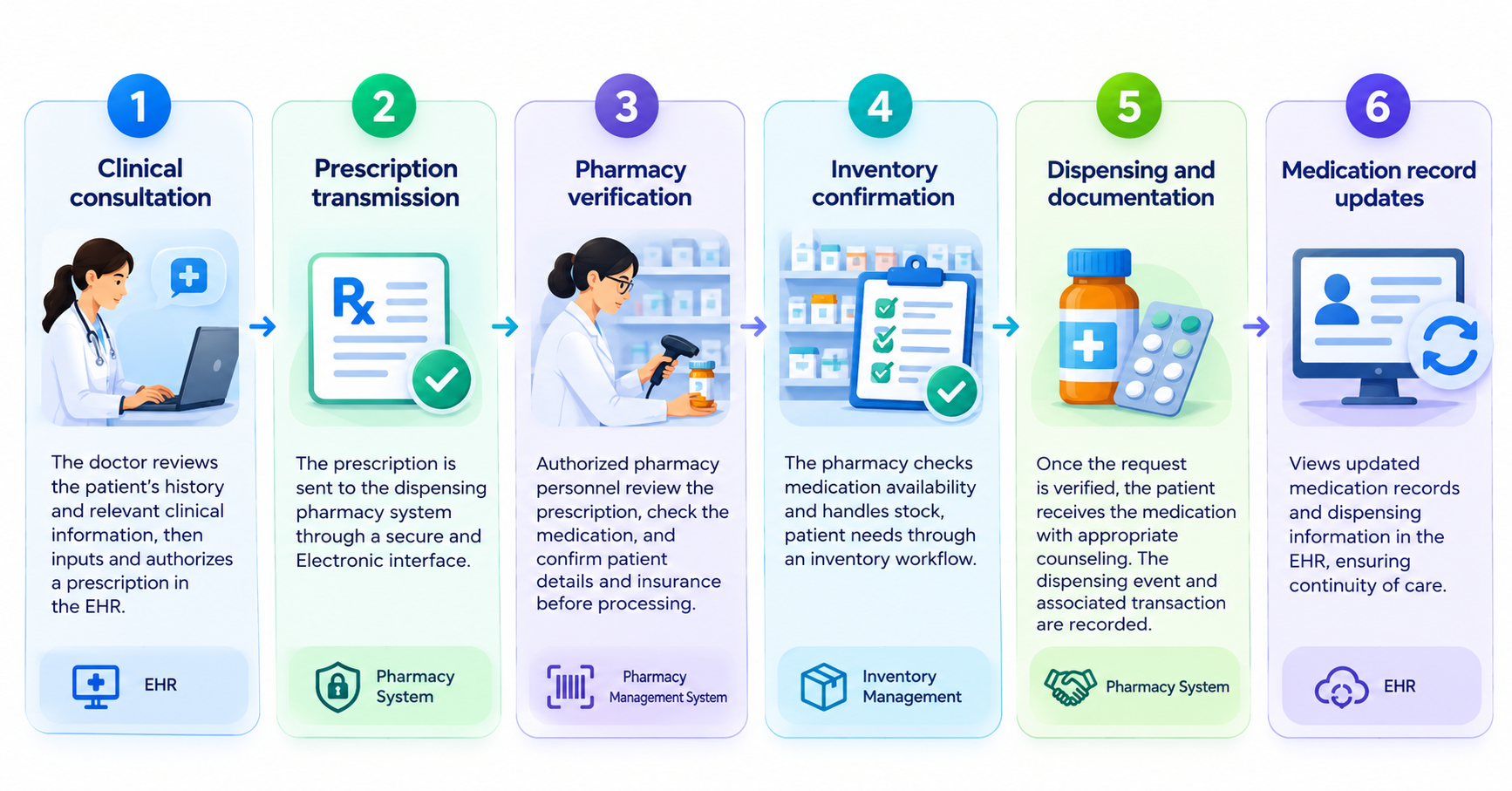
EHR integration plays an important role in connecting prescribing, pharmacy verification, inventory management, dispensing, and follow-up documentation into a more coordinated medication workflow. Agastha HealthCare Solutions focuses on connecting healthcare technology and workflows through solutions spanning Electronic Health Records (EHR), Practice Management, Medical Billing, Laboratory Information Systems (LIS), and patient engagement. By helping healthcare organizations bring relevant information and operational processes together, Agastha supports a more connected approach to managing healthcare information and coordinating care across teams.
As healthcare organizations move towards more integrated digital operations, Agastha aims to help simplify workflows, improve information accessibility, and support better operational visibility. Successful integration also depends on accurate data, secure and appropriate access, clinical oversight, trained staff, and well-defined processes. By embracing connected healthcare technology, organizations can work towards reducing administrative fragmentation and supporting continuity throughout the patient journey. Agastha EHR's - Growing with Purpose. Delivering with Passion & powering healthcare efficiency.
- *1World Health Organization. (2019). Medication safety in transitions of care. TransitionOfCare31Print
- *2 Agency for Healthcare Research and Quality. (n.d.). Medications at transitions and clinical handoffs (MATCH) toolkit for medication reconciliation. U.S. Department of Health and Human Services.Medications at Transitions and Clinical Handoffs (MATCH) Toolkit for Medication Reconciliation | Agency for Healthcare Research and Quality
- *3 Ciudad-Gutierrez, P., del Valle-Moreno, P., Lora-Escobar, S. J., Guisado-Gil, A. B., & Alfaro-Lara, E. R. (2024). Electronic medication reconciliation tools aimed at healthcare professionals to support medication reconciliation: A systematic review. Journal of Medical Systems, 48, Article 2.Electronic Medication Reconciliation Tools Aimed at Healthcare Professionals to Support Medication Reconciliation: a Systematic Review | Journal of Medical Systems | Springer Nature Link
- *4Phang, Y. Y., Kuan, J. W., Oh, A. L., Ting, C. Y., Osman, N. A., & Moses, S. (2025). Effectiveness of digital platform in reducing unintentional medication discrepancies at transition of care from hospital discharge to primary healthcare settings: A randomised controlled trial. BMC Primary Care, 26, Article 206. Effectiveness of digital platform in reducing unintentional medication discrepancies at transition of care from hospital discharge to primary healthcare settings: a randomised controlled trial - PubMed
- *5Killin, L., Hezam, A., Anderson, K. K., & Welk, B. (2021). Advanced medication reconciliation: A systematic review of the impact on medication errors and adverse drug events associated with transitions of care. The Joint Commission Journal on Quality and Patient Safety, 47(7), 438-451. Advanced Medication Reconciliation: A Systematic Review of the Impact on Medication Errors and Adverse Drug Events Associated with Transitions of Care - ScienceDirect